
The 2026 Social Media Ecosystem: A Production-Grade Operating Model
By: Jameel Ahmed Siddiqui Digital Ecosystem Architect | 22+ Years in SaaS Architecture & Growth Systems
1. The Paradigm Shift: From "Feeds" to "Intelligence Graphs"
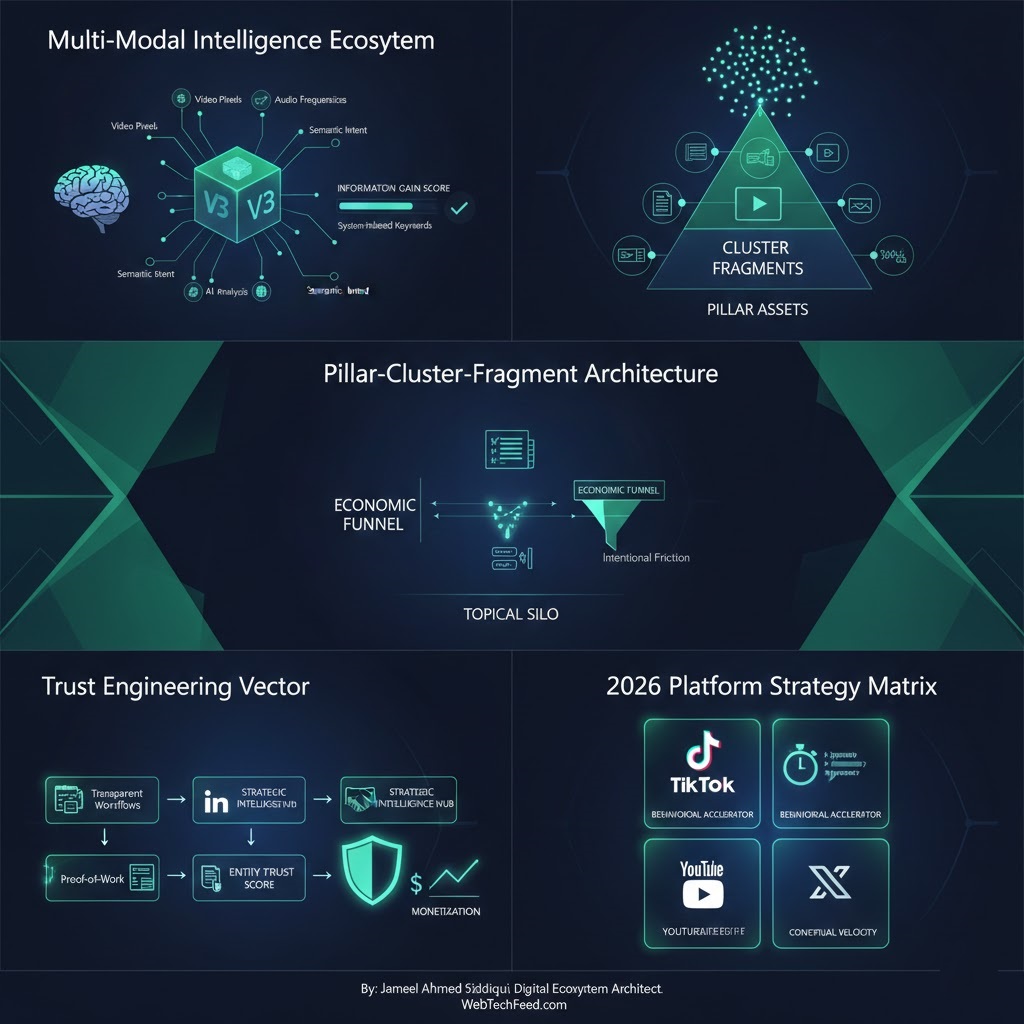
In 2026, social media has transitioned from a chronological gallery into a Behavioral Intelligence Network. Algorithms are no longer simple engagement trackers; they are Multimodal Classifiers. These systems perform real-time, deep-layer analysis of video pixels, audio frequencies, and semantic intent to determine a post's true value.
The Reality: Discovery is no longer a reward for the quantity of your output. It is a mathematical result of Information Gain—the precise measure of how much unique, non-derivative value your content contributes to the platform’s global knowledge base.
2. The Platform Strategy Matrix (2026 Edition)
TikTok: The Behavioral Accelerator
-
Technical Edge: TikTok’s V3 algorithm prioritizes Concept Density.
-
The 0.8s Rule: You must achieve "Visual Hook Equilibrium" within 800 milliseconds to prevent the scroll.
-
Execution: Use high-contrast text overlays that align with System-Indexed Keywords. Speak in "Information Bursts"—eliminating all filler words to maximize the platform's "Re-watch Velocity" score.
LinkedIn: The Strategic Intelligence Hub
-
Technical Edge: LinkedIn rewards Contextual Authority over broad reach.
-
The "Strategic Breakdown" Protocol: Replace generic updates with Logic Logs—transparent documentation of the internal architectural decisions driving your business growth.
-
Execution: Leverage native "Deep-Dive" articles to capture Long-Form Dwell Time, a metric the algorithm now uses to identify high-value B2B intent.
YouTube: The Pillar of Perpetual Trust
-
Technical Edge: YouTube functions as the internet’s Primary Knowledge Graph.
-
Session Chaining: Architect your content for Vector Alignment. If a user engages with a video on "SaaS Scaling," your next recommended "Cluster" video on "Database Security" must be mathematically aligned to their intent.
-
Execution: Implement Semantic Chaptering. Ensure your spoken transcript mirrors your metadata to provide a "Triple-Threat" signal for ai search assistants.
3. The Content Architecture System (CAS)
Do not merely "post." Deploy. Treat your content as durable digital infrastructure using the Pillar-Cluster-Fragment model:
-
Pillar Assets (The Foundation): High-complexity, "Zero-Fluff" deep dives (10+ minute videos or 2,000-word technical blueprints).
-
Cluster Fragments (The Reinforcements): 60-second "Insight Sprints" that solve specific, granular problems derived from the main Pillar.
-
Semantic Bridges: High-frequency updates that utilize Intentional Friction (e.g., "Comment 'SYSTEM' for the documentation") to bridge the gap between the public graph and your private economic funnel.
4. Trust Engineering: The AI-Proof Moat
In an era saturated with synthetic content, Human Verifiability is your only defensible competitive advantage.
-
Transparent Workflows: Document the "Messy Middle." Share the raw code, the failed marketing pivot, and the logic used to correct course.
-
Case Evidence: Replace verbal claims with Proof-of-Work. Utilize live, unedited screen-walkthroughs of your production systems.
-
Vector Consistency: Maintain a Unified Identity across the entire digital landscape. Consistent visual and verbal "tone" allows algorithms to assign your profile a higher Entity Trust Score.
5. Leverage Metrics (Moving Beyond Vanity)
Ignore "Likes"—they are lagging indicators of low-value attention. Scale your business using Alpha Metrics:
-
Save-to-Reach Ratio: The definitive indicator that your content is being utilized as a professional resource.
-
In-App Search Velocity: A measure of how many users specifically type your name or brand into the search bar—the ultimate signal of brand authority.
-
Information Gain Score: The degree to which your content provides unique data points that do not yet exist in the platform's index.
6. The Master Execution Framework
-
Daily: Deploy one Micro-Asset designed for "Pattern Interruption."
-
Weekly: Release one Authority-Level Pillar.
-
Monthly: Conduct a Semantic Audit. Analyze which "Topic Clusters" are driving "Profile Revisits" and prune low-performing nodes to maintain graph health.
Final Perspective
The 2026 landscape rewards the Architect, not the Influencer. By treating your social presence as a structured, high-velocity digital ecosystem, you transform temporary attention into a permanent economic engine. Build systems. Prove expertise. Own the graph.
Frequently Asked Questions (FAQ)
What is the "Information Gain Score" in 2026? It is a metric used by modern discovery engines to determine if a piece of content adds new facts or perspectives to the platform. Content that simply repeats existing information is suppressed, while "Zero-Fluff" original insights are amplified.
How does "Session Chaining" work on YouTube? Session Chaining is a strategy where you design multiple videos to fulfill a single, evolving user intent. By linking a broad "Pillar" video to specific "Cluster" videos, you encourage the algorithm to keep the user within your content ecosystem.
What is an "Entity Trust Score"? This is a cross-platform credibility rating assigned by AI-driven algorithms. It is built through consistent identity, verified professional credentials, and a history of providing accurate, high-value information.
Why is "Intentional Friction" useful in 2026? In 2026, getting a user to perform a specific action (like commenting a keyword) is a more powerful signal of intent than a passive like. It filters for high-quality leads and triggers the algorithm to recognize your content as highly engaging.